Update March 6, 2012: Well, the lobbying has succeeded and Microsoft has announced that they are bringing back MEC. You can get more information from MECisBack.com or read my take on the new MEC on WindowsITPro.com.
———-
I first attended the late lamented Microsoft Exchange Conference (MEC) in Austin, TX in September 1996 and had the unique experience of being assailed by Elaine Sharp, the then product manager for Exchange 4.0, who loudly inquired “how dare I write about her product”… After a short, sharp exchange of views, we partly amicably and collaborated thereafter, including working together on my Exchange 5.0 book. Such was the magic of MEC.
Of course, in those days, the sessions were all about “Migrating from MS-Mail” and similar topics. By 1998, MEC in Boston had swollen to over 4,000 attendees (http://www.microsoft.com/presspass/features/1998/9-9exchange.mspx), the sessions covered topics such as the initial “Wolfpack” clustering for Exchange 5.5, and the parties were getting more and more interesting. I don’t think some of the hotels around the World Trade Center in Boston have yet recovered from some of the parties that the development group ran.
My most embarassing experience at MEC 2000 in Dallas when I was scheduled to do a keynote in the main hall in front of several thousand people. There was a lot of excitement at MEC 2000 because of the recent introduction of Windows 2000, the Active Directory, and Exchange 2000. I can’t quite recall what the subject of the keynote was, but I ended up making a comment that it was great that the Exchange System Manager (ESM) console now supported context-sensitive menus (right-click). The older ADMIN console used by the first generation of Exchange (4.0 to 5.5) didn’t go for such UI frippery.
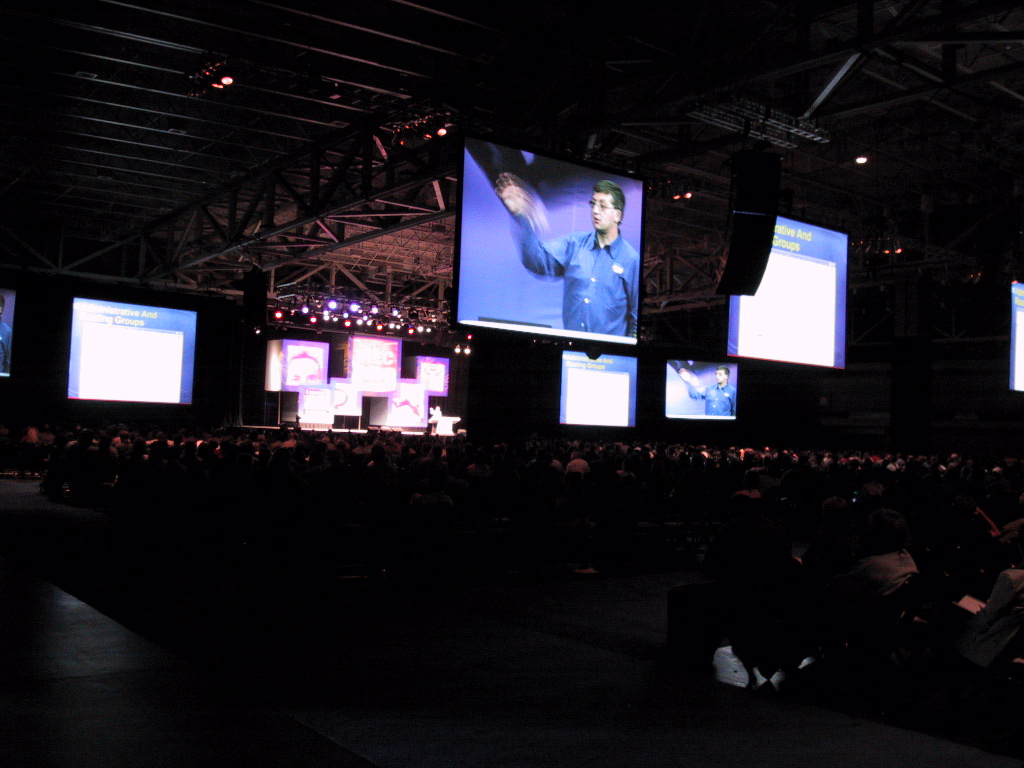
In any case, the prospect of context-sensitive menus in an administrative console obviously hit home with the crowd (thus proving the unique level of absolute geekness of the Exchange community) and resulted in generous applause. I responded with some words along the line that “I wasn’t responsible for the work, but I’d be delighted to pass on the clap to the engineers.” A horrible but short pause ensued followed by a wave of laughter as the audience realized what I had said. Of course, my face was rapidly changing from red to deeper red as the meaning of my words sank home.
Microsoft is a wonderful technology company and it came as no surprise that someone quickly captured the snippet in an MP3 file; I received many messages from Exchange engineers over the following weeks to express their delight at my words. Or maybe it wasn’t delight…
The last US-based MEC was held in Anaheim, CA in October 2002. It is worth noting that MEC ran successfully in other countries, mostly notably in EMEA where its normal location was the Acropolis in Nice, France.
Why did Microsoft drop MEC? There are many stories and the official line is that management wanted to run a single annual technology conference, which was TechEd. It might be that MEC was getting too big and that there was too much duplicated content presented at MEC and TechEd. The cut and paste disease was very obvious.
Other conferences have attempted to step in to take the place of MEC, notably the Microsoft Exchange Connections conference and The Experts Conference (TEC). The Connections conference started from a small base but now attracts a reasonable audience at its events. A good collection of Exchange MVPs hang out at the Connections event and come together to deliver sessions that are interesting and worthwhile.
I have been to a couple of TEC events and have experienced good things at the conferences, especially if you are interested in Active Directory. Directory integration and synchronization are the foundation of TEC in the past but the organizers have broadened the conference to offer more value in terms of Exchange and SharePoint recently.
Good as these conferences are, they aren’t MEC. They aren’t MEC because Microsoft doesn’t provide the same level of support to the conference in terms of the program managers and engineers who used to swarm around MEC and made the conference a unique melting point for Microsoft, its customers, and the huge number of third party companies that comprise the ecosystem that surrounds and supports Exchange. A huge amount of valuable interaction between different parties at MEC and the sessions were invariably at the 300- level or above, so the information that was gained there was unsurpassed – certainly there was a low number of marketing sessions on the MEC agenda, so the information was useful, pertinent, and clear.
I’d love to see MEC make a reappearance. TechEd is too big and bland and attempts to cover too much technology in too little time. Exchange is big enough and the complete end-to-end ecosystem, including SharePoint, is interesting enough from a technical perspective to warrant a full week’s conference, providing that the right mix of speakers was created from Microsoft engineers, industry experts, third party software developers, and customers.
What do you think?
– Tony


 Thoughtsofanidlemind's Blog
Leave a reply to MEC is back–Microsoft Exchange Conference | Lync 2010 Blog Cancel reply